
After returning from K’gari, we continued north into a part of the trip that we had been looking forward to for months: a few days on a tiny coral island right on the Great Barrier Reef. What we didn’t know yet was that this stop would become the most special one of our lives.
If you missed the previous parts, you can find Part 1 here and Part 2 here.
Rainbow Beach → Agnes Water / Town of 1770 → Gladstone → Heron Island → Airlie Beach & Whitsundays
Stop 10: Agnes Water & Town of 1770
Rainbow Beach → Agnes Water: ~4 hours
Agnes Water and the neighbouring Town of 1770 — named after the year Captain Cook landed here — are two small, sleepy beach towns that many travellers skip on their way north. In our opinion, that’s a mistake.
What makes this place special: it’s one of the very few spots on the entire Australian East Coast where you can watch the sun set over the water. Thanks to the west-facing headland at 1770, you get proper ocean sunsets — something you won’t find anywhere else along this coastline.
We rented stand-up paddle boards in Town of 1770 — just keep an eye on the tides. There are currents and sandbanks in the estuary, so it’s best to paddle upstream first and let the water carry you back, and don’t get caught out when the tide turns and the water gets shallow fast. Afterwards, we treated ourselves to some of the best fish and chips of the entire trip at a great little restaurant, before finding a spot on the headland to watch the sunset.
No big tours, no crowds, no rush — just a slow, perfect day.


Stop 11: Heron Island
Agnes Water → Gladstone: ~1.5 hours, then ~2 hours by boat
After a short morning drive to Gladstone, we boarded the ferry out to Heron Island — a tiny coral cay sitting directly on the Great Barrier Reef, about 80 km off the coast. No day trips, no through-traffic, just one island, one resort, a research station, and the reef starting right at the beach. (We’ll cover Heron Island in detail — including a full cost breakdown and tips — in a separate post.)
And what a reef it is. The snorkelling around Heron Island was hands down the most spectacular we’ve ever experienced. You simply walk off the beach, put your face in the water, and you’re surrounded by marine life:
- Reef sharks patrolling the shallows — we lost count of how many we saw
- Rays gliding over the sandy bottom
- Sea turtles everywhere, both in the water and on land
- Shark rays (also known as bowmouth guitarfish) — a bizarre and beautiful creature we had never even heard of before
- Countless fish in every colour you can imagine
The island itself is a nature reserve and home to thousands of seabirds, so there’s life (and noise) everywhere you look. But the absolute highlight came at dusk: we were lucky enough to witness baby turtles hatching and making their way across the sand into the ocean. Watching those tiny hatchlings fight their way towards the waves is something we will never forget. The cay itself is so tiny that you can walk all the way around it in well under an hour.
And it was during one of those spectacular reef sunsets that this trip became the most important one of our lives: we got engaged. 💍 There probably isn’t a more fitting place for it.
Heron Island isn’t the cheapest stop on the East Coast, and it requires a bit of planning since the ferry doesn’t run every day. But if you can make it work, it will easily become the highlight of your entire trip. It certainly was ours.
Freshly engaged and still floating, we returned to the mainland and hit the road again — this time for the long drive north towards Airlie Beach, the gateway to the Whitsunday Islands.


Stop 12: Airlie Beach & The Whitsundays
Gladstone → Airlie Beach: ~6.5 hours
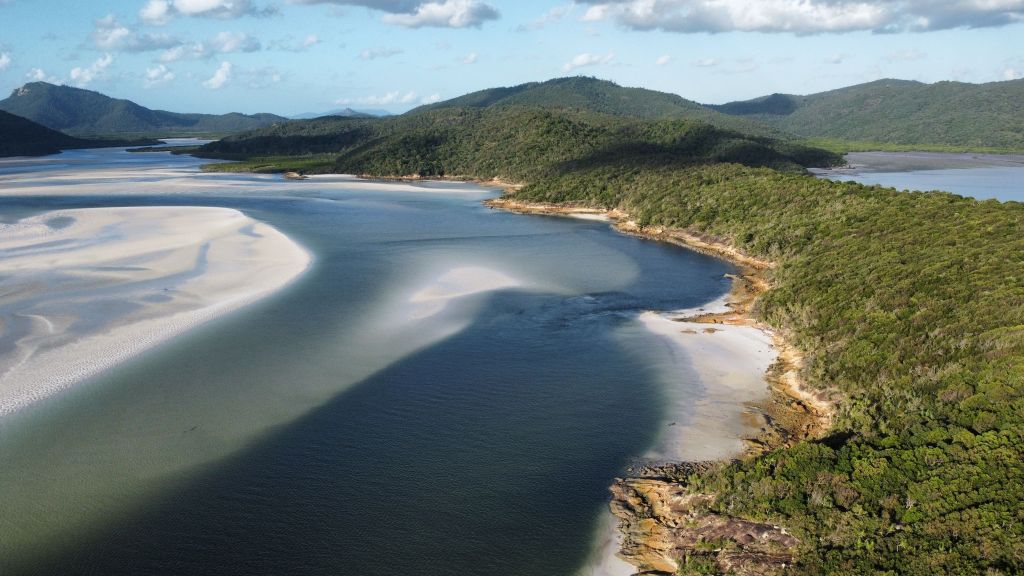
The Whitsundays are on almost every Australia East Coast itinerary — 74 islands scattered across turquoise water, home to the famous Whitehaven Beach with its swirling white silica sand. The classic way to explore them is by boat, and that’s exactly what we did: a 2-night sailing trip aboard the Solway Lass, a beautifully restored tall ship built in 1902 — the oldest sailing ship operating in the Whitsundays.
And what a life this ship has had. Built in Holland in 1902 as a cargo schooner named Stina, she spent her early years hauling freight across the North and Baltic Seas — until history caught up with her. In World War I she was seized by the British Navy and used as a decoy ship to lure German submarines; in the 1920s a Scottish owner on the Solway Firth gave her the name she still carries today. World War II saw her seized again, this time by the Germans as a supply vessel — she hit a mine, sank, and was later raised and rebuilt as a sail-powered icebreaker. After decades as a trading ship in the South Pacific, she was lovingly restored in Sydney in the 1980s and finally found her retirement home in the Whitsundays in 1999. Not many holiday boats can say they’ve survived two world wars and a sinking.
Unfortunately however, the conditions weren’t on our side. The sea was rough for most of the trip, and the underwater visibility while snorkelling was very limited. On top of that, it was jellyfish season, so we snorkelled in stinger suits — not the most glamorous look, but absolutely necessary (and included on most boats).
One encounter did make it through the murky water though: in Manta Ray Bay we met George — a giant Humphead Maori Wrasse and a genuine local celebrity in the Whitsundays (seriously, google him).
From Airlie Beach, the tropical north was finally within reach: Magnetic Island, Cairns and the ancient Daintree Rainforest were waiting. But that’s for Part 4 — the grand finale of our East Coast road trip.


Leave a comment